- Home
- About
- Academics
- Admission
- Facilities
- Centers/Cells
- Career Counselling & Placement Cell
- Coaching for Entry in Services
- Computer Training Centre
- Entrepreneur Development Cell
- IGNOU Study Centre
- Information and Technology Cell
- Internal Complaints Committee (ICC)
- IQAC
- Remedial Coaching Centre
- Right to Information Cell (RTI-Cell)
- UGC Cell
- Women’s Cell
- Yoga & Wellness Centre
- Student Life
- Editorial Venture
- Alumni
- Gallery
- Informations
Update Details

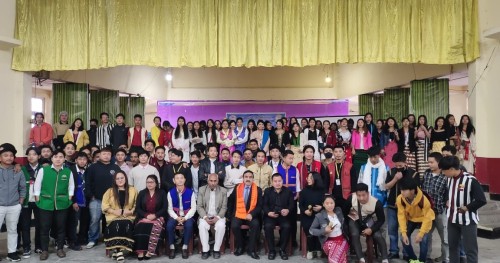
North East Educators Conclave on “National Education Policy (NEP) and its implementation”
31st January, 2024 Read More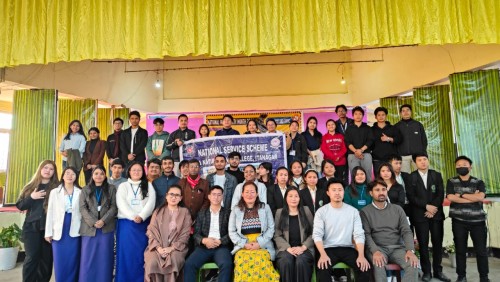

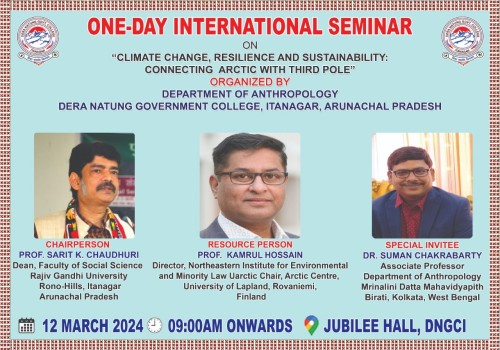
A one-day International Seminar on "Climate Change, Resilience and Sustainability Connecting Arctic with Third Pole"
12th March, 2024 Read More


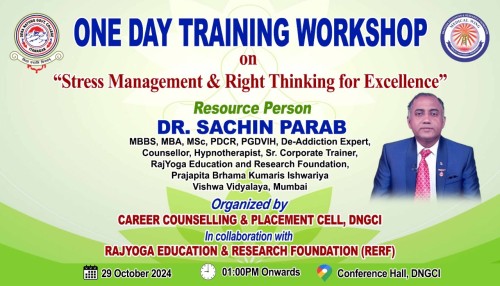
One-day training workshop on the theme ‘Stress Management and Right Thinking for Excellence’
29th October, 2024 Read More


NCC Unit DNGC Organises Blood Donation Programme on Univeral Brotherhood Day
25th August, 2025 Read More
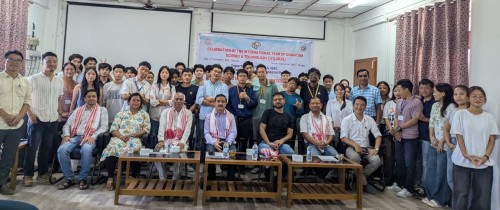
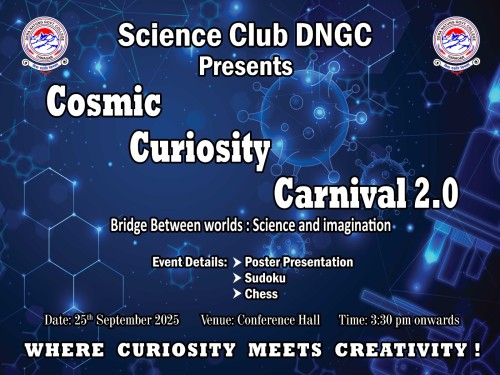


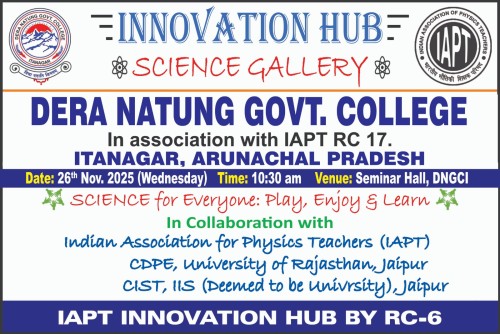
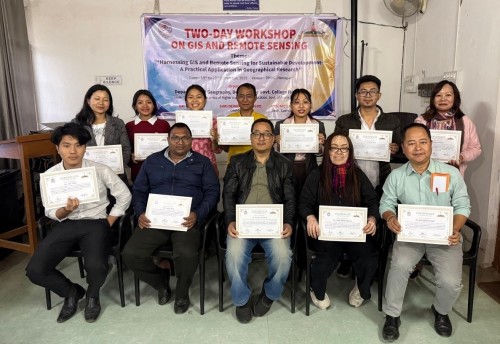


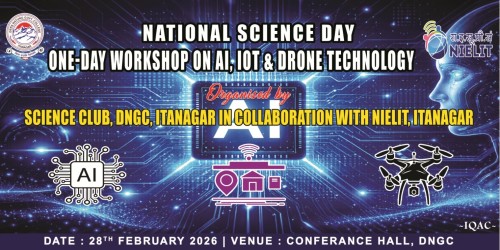
One Day Workshop on AI, IoT & Drone Technology on the occasion of National Science Day 2026
28th February, 2026 Read More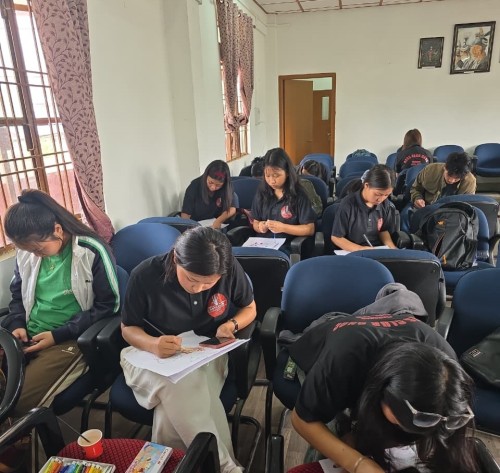
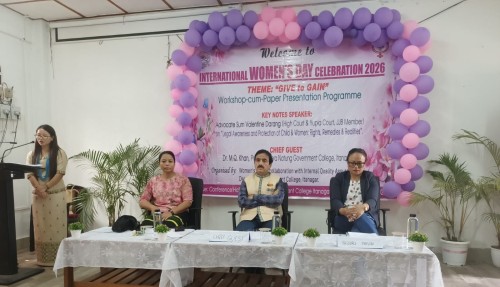
Workshop-cum-Paper Presentation on the Occasion of International Women’s Day
8th March, 2026 Read More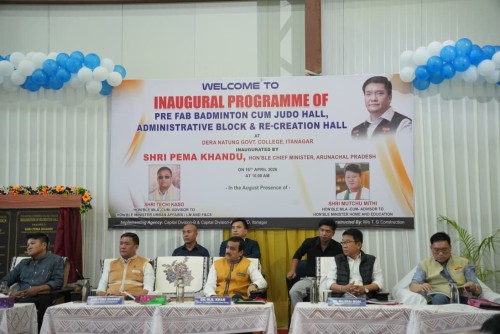
DNGC Inaugurates Badminton-cum-Judo Hall, New Administrative Block and Recreation Hall
16th April, 2026 Read More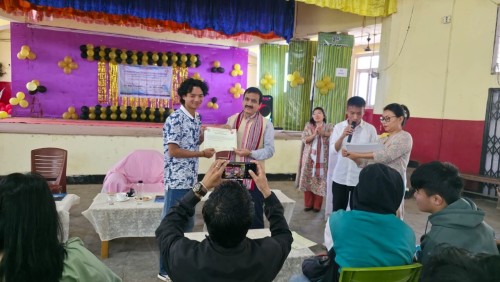
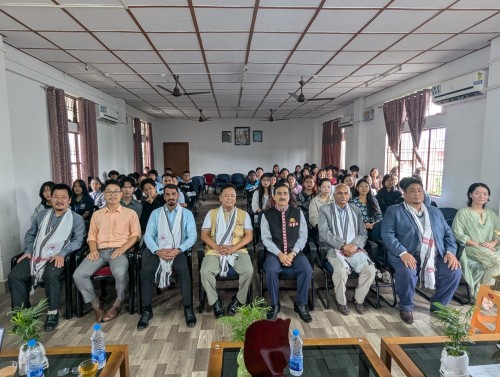
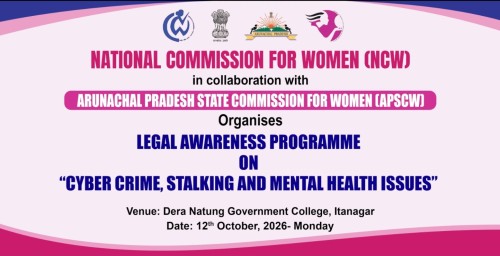
Legal Awareness Programme on Cyber Crime, Stalking and Mental Health Issues
12th October, 2026 Read More- Home
- Updates
- Awareness Programme on Cyber Security, Drug Abuse, New Criminal Laws & Police-Public Relation.
Awareness Programme on Cyber Security, Drug Abuse, New Criminal Laws & Police-Public Relation.
1st Sep, 2026, 06:00 pm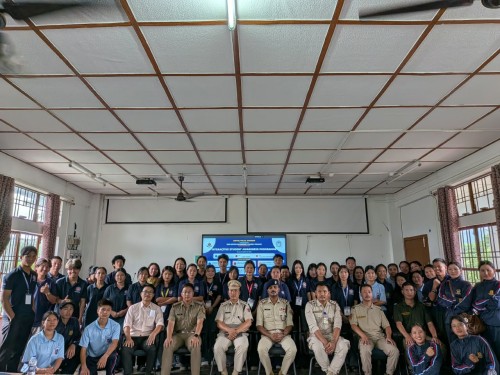
Date: 01.09.2026
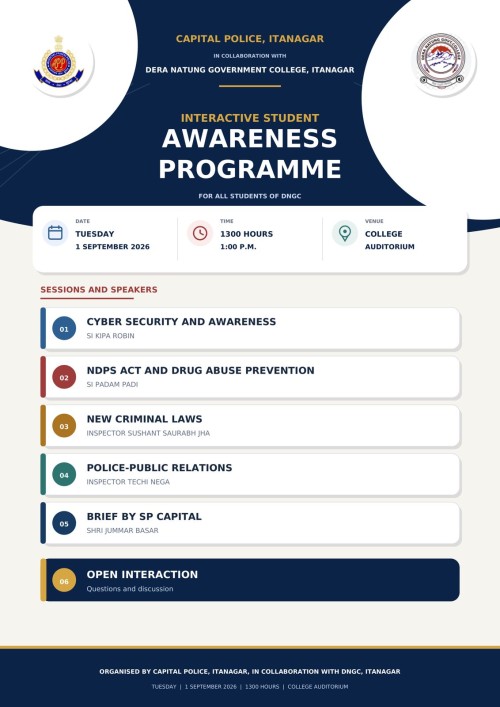
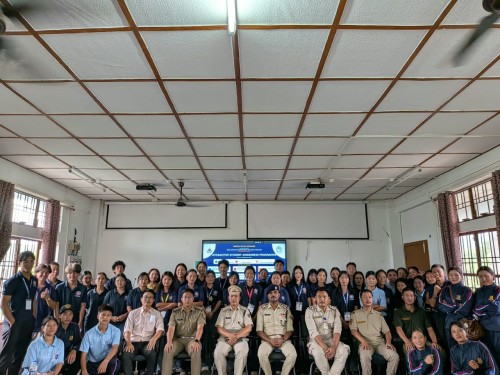
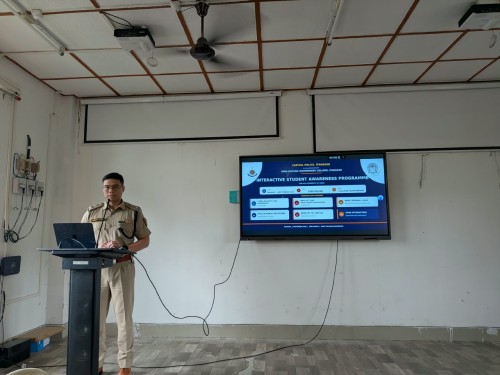
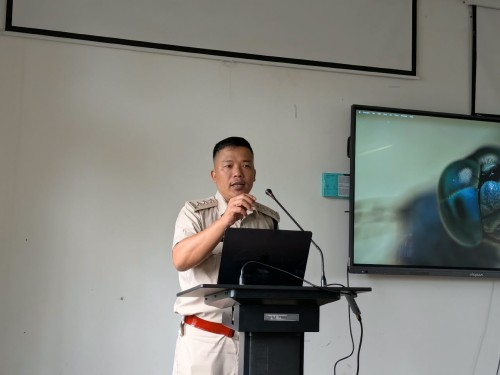
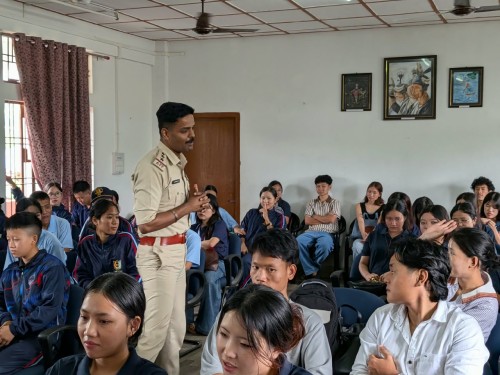
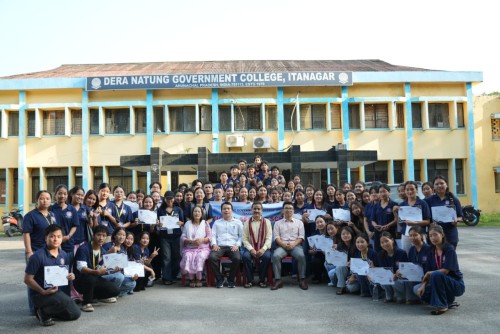
Dera Natung Government College (DNGC), Itanagar, organised an awareness programme for college students on Cyber Security and Awareness, the NDPS Act and Drug Abuse Prevention, New Criminal Laws, and Police-Public Relations on September 1, 2026, at the College Auditorium.
The programme, organised in collaboration with Capital Police, Itanagar, aimed to sensitise students about emerging challenges concerning cybercrime, drug abuse, criminal laws and the importance of constructive police-public relations.
A special briefing was delivered by SP Capital, Shri Jummar Basar, who provided an overview of the broader responsibilities of the police in maintaining law and order, preventing crime and ensuring the safety and security of the public. He highlighted the importance of coordinated efforts between law-enforcement agencies and the community in addressing emerging challenges, particularly cybercrime, drug abuse and other forms of criminal activity. He also stressed the significance of public cooperation, timely reporting of offences and responsible civic participation in strengthening the overall security environment. His briefing provided a broader perspective on the role of the Capital Police in safeguarding the community and promoting a safe, peaceful and law-abiding society.
DSP Shri Techi Nega, speaking on “Police-Public Relations,” stressed the importance of mutual trust, cooperation and communication between the police and the public. He encouraged students to view the police as an important institution for public safety and to cooperate with law-enforcement agencies in preventing crime and maintaining peace and order.
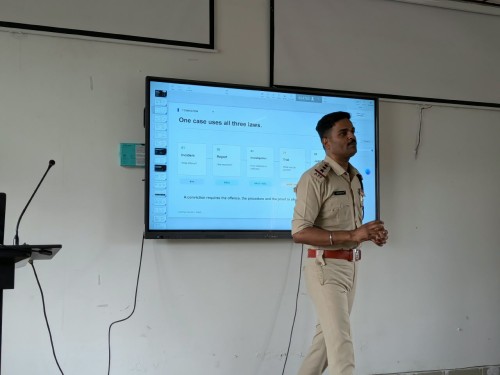
Inspector Shri Sushant Saurabh Jha spoke on “New Criminal Laws,” familiarising the students with the major changes introduced in India’s criminal justice system. He explained that the Indian Penal Code (IPC), 1860, the Code of Criminal Procedure (CrPC), 1973, and the Indian Evidence Act, 1872 have been replaced by three new laws—the Bharatiya Nyaya Sanhita (BNS), 2023, Bharatiya Nagarik Suraksha Sanhita (BNSS), 2023, and Bharatiya Sakshya Adhiniyam (BSA), 2023, which came into force on 1 July 2024.
He explained that the BNS deals primarily with offences and their punishments, replacing the IPC; the BNSS governs criminal procedure, replacing the CrPC; while the BSA deals with rules relating to evidence, replacing the Indian Evidence Act. He highlighted that the new framework places greater emphasis on modern technology, digital processes, speedy investigation and trial, and improved access to justice.
Inspector Jha also drew the students’ attention to the relevance of these changes in their everyday lives, particularly the importance of understanding their rights and responsibilities under the law. He encouraged the students to remain legally aware, responsible and informed citizens, stressing that knowledge of the law can help prevent offences, promote responsible behaviour and strengthen public confidence in the criminal justice system.
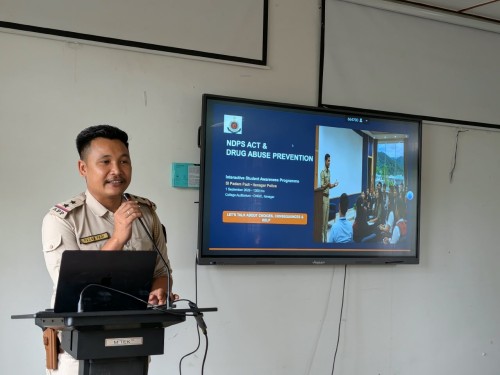
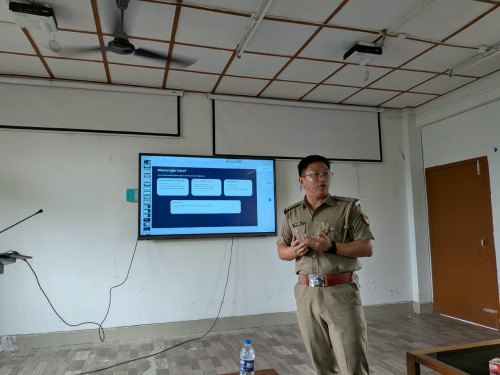
Speaking on “Cyber Security and Awareness,” Sub-Inspector Shri Kipa Robin highlighted the growing risks faced by students in the digital age. He sensitised the students about common cybercrimes such as phishing, UPI and QR-code fraud, social-media impersonation, cyberbullying, stalking, sextortion, and fake job or scholarship offers. He urged students to follow the basic principle of “Pause before you click, verify before you trust, and report quickly if something goes wrong.” Students were also informed about the importance of protecting passwords, OTPs and personal information, enabling two-factor authentication, and reporting financial cyber fraud immediately through 1930.Sub-Inspector Shri Padam Padi addressed the students on “NDPS Act and Drug Abuse Prevention.” In an interactive session, he discussed the factors that can lead young people towards substance abuse, including curiosity, peer pressure, stress and social situations. He explained that drug abuse can adversely affect physical and mental well-being, academic performance, relationships, finances and future prospects. He also familiarised students with the practical implications of the Narcotic Drugs and Psychotropic Substances (NDPS) Act, 1985, cautioning them against possessing, carrying, storing, transporting or concealing suspicious substances for others. Emphasising the importance of early intervention, Shri Padi urged students not to shame those struggling with drug dependence but to encourage them to seek appropriate help and support. He shared the message “NO, MOVE, TELL, HELP”—refuse drugs, leave risky situations, tell a trusted person or authority when necessary, and help those in need of professional support. The session also highlighted emergency and assistance helplines, including 112, 14446 for de-addiction counselling and referral, and 1933 (MANAS) for drug-related matters.
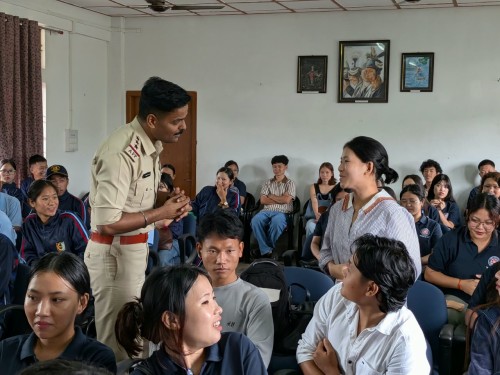
The programme provided students with an opportunity to interact directly with police officers and gain practical knowledge about contemporary challenges affecting young people. The sessions also encouraged students to be responsible digital citizens, stay away from substance abuse, understand their rights and responsibilities under the law, and maintain positive engagement with law-enforcement agencies.
The programme concluded with a call to students to remain aware, responsible and proactive citizens, contributing positively to a safer and more informed society.